
EN 1522 is the European standard that governs ballistic resistance for roller shutters, doors, and windows. When a project requires protection against firearms, this is the standard your specification should reference — not a manufacturer’s claim, not a marketing rating, but a third-party certified EN 1522 classification with a documented test report. This guide explains what each FB level means, what weapons it corresponds to, and how to select the correct classification for your facility type.
What EN 1522 covers and what it does not
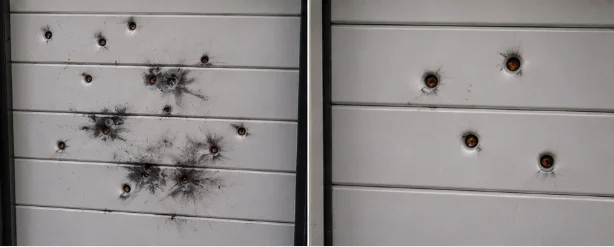 EN 1522:1999 defines the requirements and test methodology for bullet resistance in windows, doors, shutters, and blinds. It is complemented by EN 1523, which defines the test procedure itself. Together they form the complete ballistic specification framework for architectural security elements in Europe.
The standard applies to the complete installed element — not just the infill material. A shutter certified to FB6 has been tested as an assembled unit: slats, frame, guides, locking mechanism, and all connections. A product where only the slat material is tested to FB6 does not carry FB6 certification for the shutter as a whole. This distinction matters for procurement: always request the test report for the complete element, not the material specification.
EN 1522 does not cover intrusion resistance (governed by EN 1627), blast resistance (EN 13123), or fire resistance (EN 1634). Each threat type requires its own certification. A shutter with FB6 ballistic certification is not inherently blast-resistant unless it also holds an EXR certification under EN 13123.
EN 1522 FB classification levels — what each level means
The standard defines seven levels of ballistic resistance, FB1 through FB7, plus one additional level FSG for shotgun ammunition. Each level corresponds to a specific weapon and ammunition type, tested at a defined distance with a specified number of shots.
| Level | Weapon type | Calibre | Test distance | Typical application |
|---|---|---|---|---|
| FB1 | Rifle / carbine | .22 LR | 10 m | Low-risk retail, residential |
| FB2 | Handgun | 9 mm Luger | 5 m | Commercial premises, offices |
| FB3 | Handgun | .357 Magnum | 5 m | Banks, jewellery retail |
| FB4 | Handgun | .44 Magnum | 5 m | Financial institutions, cash handling |
| FB5 | Rifle | 5.56 × 45 mm | 10 m | Military perimeters, embassies |
| FB6 | Rifle | 5.56 × 45 mm + 7.62 × 51 mm | 10 m | High-risk embassies, government facilities |
| FB7 | Rifle | 7.62 × 51 mm hard core | 10 m | Maximum-risk military and government |
| FSG | Shotgun | 12/70 | 10 m | Specific threat environments |
The suffix S (Splinter) indicates that splinters may be generated on the protected side after impact. The suffix NS (No Splinter) certifies that no dangerous fragments are produced — a critical requirement when personnel are present on the protected side. For all facility types with occupied interiors, NS certification should be the minimum specification at FB4 and above.
FB4 vs FB5 vs FB6 — where the line is drawn for serious specifications
FB4 (.44 Magnum) addresses the threat envelope of high-powered handguns. It is appropriate for retail banking branches, jewellery stores, pharmacies handling controlled substances, and commercial premises with a documented handgun threat. It does not address rifle fire.
FB5 (5.56 × 45 mm NATO) enters the rifle threat envelope. The 5.56 mm round is the standard NATO assault rifle calibre used in weapons including the M16, AR-15, and FAMAS. FB5 is the minimum appropriate specification for any facility where a rifle attack is assessed as a credible threat: diplomatic facilities in medium-risk environments, military administrative buildings, police headquarters.
FB6 (5.56 × 45 mm and 7.62 × 51 mm) adds resistance to the 7.62 × 51 mm NATO round — the calibre used in weapons including the FN FAL, G3, and medium machine guns. It also provides resistance to the 7.62 × 39 mm round used in the AK-47, since 7.62 × 51 mm has greater penetration capability. FB6-NS is therefore the standard specification for embassies in high-risk regions, government compound perimeters, and critical infrastructure access points where military-grade rifle fire is a credible threat vector.
How to specify ballistic protection correctly: what architects and procurement need to request
A complete ballistic specification for a roller shutter or security door must include the following elements to be technically valid for procurement:
Standard reference: EN 1522:1999 with the specific FB level and splinter suffix (e.g., FB6-NS). Do not specify FB level alone without the NS/S designation when personnel protection is required.
Test report: Issued by an accredited independent laboratory. The test report must reference the specific product model and dimensions tested, the weapon and ammunition used, the test distance, the number of shots, and the classification result. Manufacturer declarations are not equivalent to certified test reports.
Tested dimensions: Ballistic certification is specific to the tested configuration. A shutter certified at 3000 × 3000 mm does not automatically carry the same certification at 4500 × 4000 mm. Confirm that the certified dimensions cover your project’s opening, or that a new test or engineering assessment has been conducted for larger openings.
Combined certifications: If the facility requires both ballistic and intrusion resistance, specify both EN 1522 (FB level) and EN 1627 (RC level) separately. If blast resistance is also required, add EN 13123-2 (EXR level). Each standard governs a distinct threat type and must be independently certified.
FB6-NS roller shutters for high-risk facilities
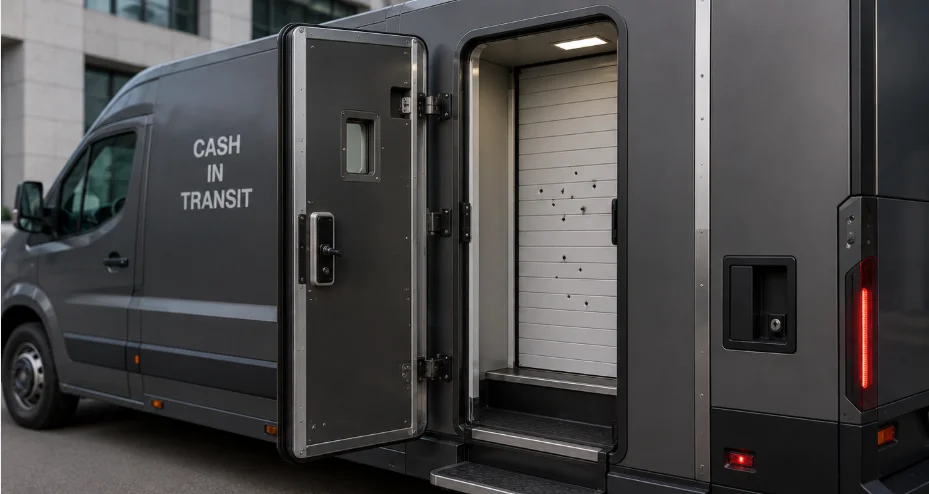
FB6-NS represents the most demanding ballistic specification routinely applied to roller shutters in European and international security projects. It addresses the AK-47 threat envelope, which is the relevant baseline for diplomatic facilities, government compounds, and military access points in conflict-adjacent environments.
CBX Security’s Diamond BL and Diamond BL X-TREME series are certified to FB6-NS under EN 1522:1999. The Diamond BL X-TREME combines FB6-NS ballistic resistance with RC6 intrusion resistance under EN 1627, and is available in a version that also carries EXR5-NS blast certification under EN 13123-2 — the only roller shutter in the world to hold all three certifications simultaneously.
For ballistic glazing specifications, the parallel standard is EN 1063, which governs glass and transparent elements. The BR levels in EN 1063 correspond approximately to the FB levels in EN 1522, but they are not identical and should not be used interchangeably in specifications. See our guide on bulletproof windows and high-security glazing for EN 1063 classification details.
Common specification errors to avoid
Specifying FB level without NS designation when personnel are present on the protected side. At FB5 and above, splinter generation on the interior face is a serious injury hazard. NS should be the default for all occupied facilities.
Accepting material-level ballistic ratings as product certifications. A shutter manufacturer claiming the slat material meets FB6 has not certified the shutter to FB6. The complete assembled element must be tested.
Confusing EN 1522 and EN 1627. EN 1522 governs bullets. EN 1627 governs forced entry with tools. A shutter certified only to RC6 is not bulletproof. A shutter certified only to FB6 is not necessarily intrusion-resistant under EN 1627. For comprehensive protection, both certifications are required.
Omitting dimension confirmation. For large openings — vehicular gates, loading bays, wide façade shutters — always confirm that the certified test dimensions cover the required opening size, or request engineering documentation for larger configurations.
If you are specifying FB6-NS ballistic shutters for a diplomatic facility, government building, or critical infrastructure project, CBX Security’s technical team provides certified documentation, product datasheets in DWG and PDF format, and project-specific specification support. Contact us to request a technical quote or download specification sheets for the Diamond BL series.