
When specifying physical protection for a facility under genuine explosion risk, the EXR classification is the metric that matters. It defines not just whether a shutter will survive a blast, but whether it will remain impassable, contain fragmentation, and keep personnel safe. Understanding the difference between EXR4 and EXR5 — and what each level demands from a product — is the starting point for any serious specification.
What is EN 13123 and why does it govern blast resistance?
EN 13123 is the European standard that defines how doors, windows, and shutters are tested and classified for resistance to explosion. It exists in two parts with different test methodologies.
EN 13123-1 covers deflagration (shock tube testing). It is applied to industrial settings where the explosion source is internal — petrochemical plants, gas facilities. Classification runs from EPR1 to EPR4.
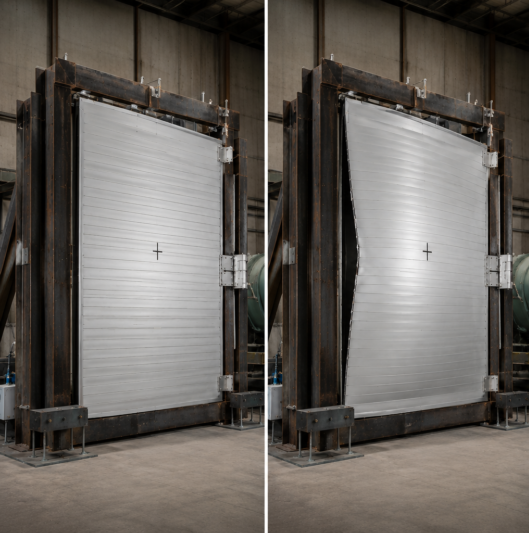
EN 13123-2 covers detonation (outdoor testing with live explosive charges). This is the relevant standard for security applications: embassies, government buildings, military facilities, financial institutions. Classification runs from EXR1 to EXR5. For security architecture, EN 13123-2 is the operative standard.
EXR classification levels — what each level means
Each EXR level is defined by the mass of the TNT charge and the distance from the element being tested. The test determines whether the element remains intact, impassable, and does not produce dangerous fragments on the protected side.
| Level | TNT charge | Distance | Typical applications |
|---|---|---|---|
| EXR1 | 3 kg | 5 m | Low-risk commercial perimeters |
| EXR2 | 6 kg | 4 m | Private secure facilities |
| EXR3 | 8 kg | 4 m | Financial institutions, retail security |
| EXR4 | 12 kg | 4 m | Military perimeters, secure infrastructure |
| EXR5 | 20 kg | 4 m | Embassies, government facilities, critical infrastructure |
The suffix NS (No Splinter) is added when the element, in addition to remaining impassable, does not generate dangerous fragments on the interior face. NS certification is a mandatory requirement in most diplomatic and government procurement specifications, because fragmentation from a structural element is itself a lethal hazard.
EXR4 vs EXR5 — where the difference matters
The gap between EXR4 and EXR5 is not a marginal engineering increment. It represents a 67% increase in explosive charge — from 12 kg to 20 kg of TNT — at the same standoff distance of 4 metres. A typical vehicle-borne improvised explosive device (VBIED) deployed in proximity to a building perimeter falls within the EXR5 threat envelope.
EXR4 is appropriate for facilities where the explosion threat is assessed as significant but bounded: military access control points at lower-risk installations, financial vaults, secondary perimeter protection at critical sites.
EXR5 is specified when the threat assessment includes deliberate, high-mass explosive attacks on a primary perimeter: embassies in high-risk regions, ministerial compounds, central bank facilities, airport security perimeters in conflict-adjacent environments. If your security assessment identifies a VBIED scenario as credible, the specification must begin at EXR5.
What products actually achieve EXR5-NS?
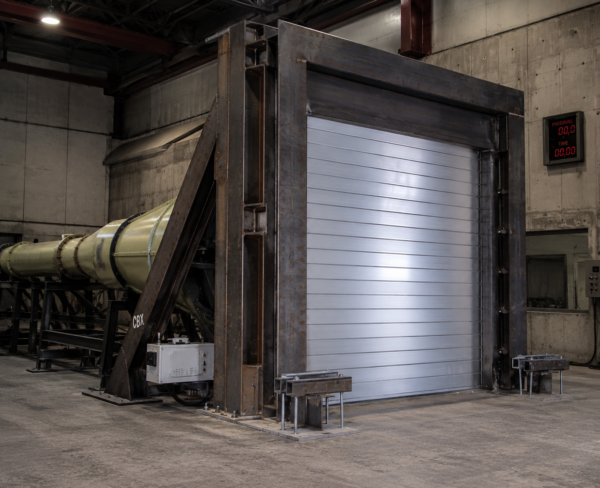
EXR5-NS certification for roller shutters is exceptionally rare. The combination of blast wave absorption, structural integrity, and zero fragmentation on the protected face eliminates most conventional shutter constructions and demands a purpose-engineered element.
CBX Security’s Diamond BL X-TREME is the only roller shutter in the world certified to EXR5-NS under EN 13123-2:2004. In addition, it combines in a single element:
- RC6 under EN 1627:2011 — maximum anti-intrusion resistance
- FB6-NS under EN 1522:1999 — resistance to heavy-calibre ballistic fire including AK-47
- E60 under EN 1634-1 — fire resistance for 60 minutes
- Class 5 under EN 12424 — maximum wind load resistance
This combination of blast, ballistic, intrusion, fire, and wind protection in one certified element is not available from any other roller shutter manufacturer globally.
Real applications where EXR5-NS is specified
The following facility types routinely require EXR5 at primary perimeter openings:
Embassies and diplomatic missions — particularly in regions with elevated political or conflict risk. NS certification is a non-negotiable requirement due to personnel safety obligations.
Central banks and high-value asset facilities — the combination of blast and ballistic risk at vehicular entrances drives EXR5 specification, often alongside anti-ram bollards and access control.
Military and government compound perimeters — vehicular gates and loading bay access points at installations in conflict-adjacent environments.
Airport security perimeters — cargo and ground-operations access points at international airports in high-risk regions, where VBIED scenarios are included in security planning.
Critical infrastructure nodes — power generation, data centers, water treatment facilities identified as strategic targets under national infrastructure protection frameworks.
What to request from a supplier when specifying EXR5-NS
A product claiming EXR5-NS compliance must provide the following documentation before specification is finalised:
Certified test report from an accredited laboratory, referencing EN 13123-2:2004, the explosive charge and distance used, and the classification result. Manufacturer self-certification is not acceptable for EXR5 specification.
Product dimensions tested — blast performance is specific to the tested configuration. A product certified at a particular width and height may not carry the same certification at different dimensions.
NS classification evidence — the NS suffix requires explicit confirmation in the test report that no dangerous fragments were produced on the protected face. This is a separate test criterion and must be documented independently.
Installation specification — a blast-certified element installed incorrectly will not perform to its certified rating. The supplier must provide a certified installation methodology.
CBX Security provides full documentation for all of the above on project request. If you are specifying blast protection for an embassy, government facility, or critical infrastructure node, contact our technical team for certified documentation, datasheets, and specification support.