
The United Arab Emirates hosts over 200 diplomatic missions, dozens of international financial institutions, and a growing portfolio of critical infrastructure projects including NEOM-adjacent developments, data centres, and luxury residential compounds. For procurement managers, security consultants and architects specifying physical protection in this environment, the question is not whether high-security shutters are required — it is which certification levels apply and which suppliers can provide verified documentation for local compliance processes.
What certification levels apply to high-security projects in the UAE
The UAE security sector is regulated by the Security Industry Regulatory Agency (SIRA) for Dubai and equivalent authorities across the Emirates. For ballistic and blast-resistant architectural elements, the applicable international standards are the same European norms required in diplomatic procurement globally:
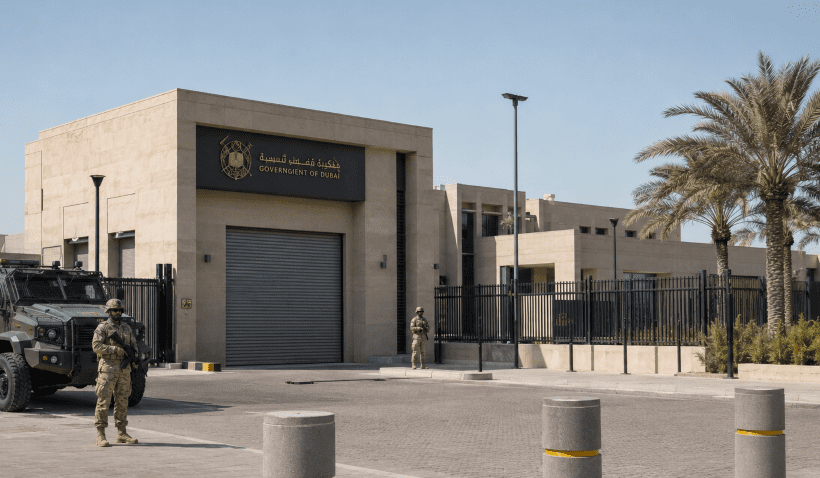
EN 1522:1999 governs bullet resistance for shutters, doors and windows. For embassy and government facility specifications in the UAE, the minimum required level is FB6-NS — resistance to 7.62 × 51 mm NATO rifle ammunition including AK-47 calibre, with no dangerous fragments on the protected side. The NS suffix is non-negotiable for any occupied interior.
EN 13123-2:2004 governs blast resistance by detonation. For vehicular access points at embassies, financial institutions and government compounds in the UAE, the relevant level is EXR5-NS — resistance to 20 kg of TNT detonated at 4 metres. This covers the vehicle-borne IED (VBIED) threat scenario that drives security planning for high-value facilities across the GCC region.
EN 1627:2011 governs forced entry resistance. For primary perimeter access points, RC6 is the standard specification for UAE diplomatic and government projects.
Protection levels by access type — UAE facility specifications
Specifications vary by zone and threat assessment. The following table reflects the levels typically required in UAE government and diplomatic procurement:
| Access type | Ballistic level | Blast resistance | Intrusion resistance |
|---|---|---|---|
| Main vehicular access | FB6-NS | EXR5-NS | RC6 |
| Personnel entry — security checkpoint | FB5-NS | EXR4 | RC5 |
| Secure document storage / communications room | FB6-NS | EXR4 | RC6 |
| Reception and public access areas | FB4-NS | Not required | RC4 |
| Secondary and service access | FB4-NS | EXR3 | RC4 |
| Luxury residential — safe room access | FB4-NS | Not required | RC5 |
Exact levels must be confirmed through a formal threat assessment conducted by the facility’s security authority. The table above reflects standard procurement baselines for UAE projects.
Why UAE projects increasingly specify EXR5-NS
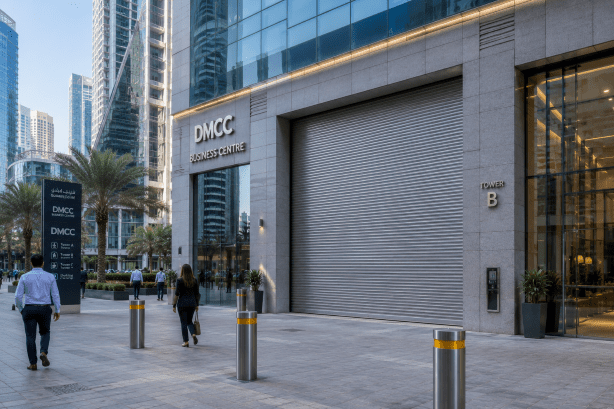
The GCC region has seen a significant increase in specifications requiring combined ballistic and blast certification over the past five years. Several factors drive this:
VBIED threat assessment. Vehicle-borne explosive devices remain the primary high-consequence threat to embassies and government facilities across the Middle East. EXR5-NS certification — covering 20 kg TNT at 4 metres — is the standard response to this assessment at primary vehicular access points.
NEOM and Vision 2030 infrastructure. Large-scale infrastructure projects in Saudi Arabia adjacent to UAE supply chains increasingly require physical security specifications that match or exceed those applied to diplomatic facilities. Contractors sourcing security elements for these projects operate under combined ballistic and blast requirements.
Data centre expansion. The UAE is one of the fastest-growing data centre markets globally. Physical security requirements for Tier III and Tier IV facilities include forced entry resistance (RC4–RC5) and, in some specifications, ballistic protection for primary access shutters.
Luxury residential and private compound security. High-net-worth residential developments in Dubai, Abu Dhabi and Sharjah increasingly incorporate safe room and panic room specifications that require FB4–FB6 ballistic protection for access shutters and doors.
The Diamond BL X-TREME — the only roller shutter certified to EXR5-NS
CBX Security’s Diamond BL X-TREME is the only roller shutter in the world certified simultaneously to the three maximum protection levels required for high-risk facilities in the UAE and GCC region:
- FB6-NS under EN 1522:1999 — AK-47 and NATO assault rifle calibre, no interior fragmentation
- EXR5-NS under EN 13123-2:2004 — 20 kg TNT at 4 metres, no interior fragmentation
- RC6 under EN 1627:2011 — maximum forced entry resistance
- E60 under EN 1634-1 — 60-minute fire resistance
- Class 5 under EN 12424 — maximum wind load resistance
No other roller shutter manufacturer holds EXR5-NS certification under EN 13123-2. This certification was obtained through live detonation testing at an accredited laboratory. The full test report is available for review in tender and procurement processes.
Supply, installation and documentation for UAE projects
CBX Security supplies certified high-security shutters to projects across the UAE, Saudi Arabia and Qatar. For UAE-based procurement, we provide:
- Independent laboratory test reports for EN 1522, EN 13123-2 and EN 1627 certifications
- Technical datasheets in PDF and DWG format for integration into project drawings
- Technical specification language compatible with UAE and international tender documentation
- Direct technical support for adaptation to project-specific opening dimensions and operational requirements
- International supply and installation coordination for projects across the GCC
Common specification errors in UAE high-security projects
Specifying ballistic level without the NS suffix when personnel occupy the protected side. Above FB4, fragmentation on the interior face is a serious injury risk. NS is mandatory for all occupied zones.
Accepting material-level certification as product certification. A manufacturer certifying only the aluminium slat profile has not certified the assembled shutter. The test report must reference the complete element in its project dimensions.
Not verifying that tested dimensions cover the project opening. Ballistic and blast certification is specific to the tested configuration. For large-format vehicular access shutters, confirm that the certified element covers the required width and height, or request engineering documentation for non-standard dimensions.
Specifying a single standard without considering combined threat. A shutter with FB6 but no EXR certification does not protect against explosives. For embassy and government facility specifications in the UAE, both threat types must be addressed simultaneously.
If you are preparing a security specification for an embassy, government facility, data centre or high-value residential project in the UAE or wider GCC region and require certified documentation, technical datasheets or specification support, contact CBX Security’s technical team. We provide full support for tender and procurement processes in the UAE and across international markets.