
A bank branch is one of the most consistently targeted commercial premises in the world. The combination of high-value assets, predictable operating hours, and large facade openings makes it a facility where the quality of physical security directly determines the outcome of an attack. A window or service opening protected by a standard commercial shutter offers no meaningful resistance to armed robbery, ballistic attack, or a vehicle ramming attempt. It offers the appearance of closure without the substance of protection.
Bulletproof shutters for banks are not an upgrade on standard security hardware. They are a categorically different class of product — certified against specific threat levels under European standards, tested under controlled laboratory conditions, and specified as part of a coordinated physical security strategy that addresses every vulnerable opening in the facility.
Why Banks Require Certified Ballistic Protection
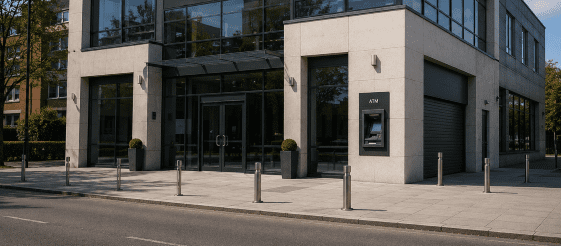
The threat profile of a bank branch has several characteristics that distinguish it from other commercial premises. Cash handling, vault access, and the presence of high-value items create a target profile that attracts organised and armed criminal activity. ATM vestibules, teller windows, cash management areas, and night deposit openings are points where the facade is both operationally necessary and physically vulnerable.
Three threat categories define the specification requirements for bank shutters:
Ballistic Attack
Armed robbery involving firearms is the primary ballistic threat in banking environments. The relevant certification standard is EN 1522, which defines ballistic resistance classes FB2 through FB7. Each class corresponds to a specific weapon type and projectile energy that the tested product must resist without penetration and without dangerous spalling on the interior side. For most banking applications in Europe, FB4 provides resistance against handgun fire including .44 Magnum. FB6 provides resistance against high-powered rifle fire.
Forced Entry and Smash-and-Grab
Organised smash-and-grab attacks — typically involving vehicles or heavy tools applied rapidly to a facade opening — are a documented threat pattern for retail banking premises. EN 1627 defines resistance classes RC2 through RC6 based on the time, tools, and applied force required to defeat the closure. Banking premises in high-risk locations typically require RC4 or RC5 as a minimum for critical openings including ATM vestibules and cash handling areas.
Vehicle Ramming
Vehicle-borne attacks against ATM enclosures and bank frontages have increased across European markets. A shutter that holds its ballistic certification under projectile impact may not be specified to resist the sustained mechanical force of a vehicle impact. This distinction matters at specification stage — the two threat types require different structural configurations and guide systems.
European Certification Standards for Bank Shutters
Correct specification requires understanding which standard applies to which threat. These certifications are tested independently and a product can hold one without the other.
| Standard | Threat | Classes | Banking application |
|---|---|---|---|
| EN 1522 | Ballistic attack — firearms | FB2 to FB7 | Teller windows, cash areas, ATM vestibules |
| EN 1627 | Forced entry — manual and mechanical attack | RC2 to RC6 | All exterior openings, service bays |
| EN 13123-2 | Explosion and blast overpressure | EXR1 to EXR5-NS | Central banks, high-value vaults, critical facilities |
For standard retail banking branches, EN 1522 at FB4 combined with EN 1627 at RC4 addresses the primary threat profile in most European markets. Central banks, currency processing facilities, and high-value storage operations require higher specifications — often FB6 or FB7 for ballistic resistance and RC5 or RC6 for forced entry, with blast resistance under EN 13123-2 for the most critical openings.
Matching Protection Level to the Opening Type
Not every opening in a banking facility carries the same risk profile. A coherent physical security specification assigns protection levels based on the function and exposure of each opening rather than applying a single specification across the entire facade.
| Opening type | Risk profile | Recommended minimum |
|---|---|---|
| ATM vestibule facade | High — vehicle ramming, smash-and-grab, overnight attack | EN 1522 FB4 + EN 1627 RC4 |
| Teller area windows | High — ballistic attack during opening hours | EN 1522 FB4–FB6 |
| Main branch facade | Medium-high — smash-and-grab, forced entry | EN 1627 RC3–RC4 |
| Cash management / vault access | Very high — organised armed attack | EN 1522 FB6 + EN 1627 RC5 |
| Central bank / currency facility | Extreme — all threat categories including blast | EN 1522 FB7 + EN 1627 RC6 + EN 13123-2 EXR |
CBX Security Certified Systems for Banking Applications
CBX Security manufactures a range of certified high-security roller shutters for banking and financial institution applications. All products are available with full certification documentation for project submission, regulatory compliance, and insurance requirements.
Diamond BL — Ballistic and Forced-Entry Certified
The Diamond BL is the primary specification for banking premises requiring combined ballistic and forced-entry resistance. It holds certification under EN 1522 for ballistic resistance and EN 1627 for forced-entry resistance, providing simultaneous multi-threat protection from a single certified product. The Diamond BL is the specification of choice for retail banking branches, ATM enclosures, and cash management facilities where FB4–FB6 ballistic resistance combined with RC4–RC5 forced-entry resistance is required.
Diamond BL X-TREME — Maximum Protection for Critical Financial Facilities
The Diamond BL X-TREME is the only roller shutter in the world certified to EXR5-NS under EN 13123-2:2004 — the maximum blast resistance classification available under the European standard. For central banks, currency processing centres, and high-value vault facilities where the threat profile includes explosive attack alongside ballistic and forced-entry risk, the Diamond BL X-TREME provides protection across all three threat categories from a single certified product.
SECURBAIX — Forced-Entry Certified for Secondary Openings
The SECURBAIX provides certified forced-entry resistance under EN 1627 at RC4. It is the appropriate specification for secondary access points, service entrances, and internal security zones within banking facilities where ballistic resistance is not required but forced-entry resistance must meet high-security standards.
Operational Requirements in Banking Environments
Banking premises operate on precise schedules. CBX Security shutter systems for banking applications address operational requirements alongside certified protection:
- Motorised operation: All Diamond series shutters operate via motor drive with remote control and building management system integration.
- Emergency manual override: Manual operation capability is standard for all products, ensuring operation during power failure or emergency conditions.
- Access control integration: Systems are compatible with standard access control protocols for time-scheduled operation and authorised-user control.
- Alarm system integration: Tamper detection and position monitoring can be integrated with the facility’s alarm and monitoring infrastructure.
- Architectural finish: Housing and guide configurations are available in standard RAL colours and architectural finishes for integration into branded retail banking environments.
Specifying Bulletproof Shutters for a Banking Project
A complete shutter specification for a banking facility begins with a threat assessment that establishes the required protection class for each opening type. Certification documentation, accredited test reports, and full installation specifications are available for all products in the Diamond series range and can be provided in the formats required for project submission, insurance compliance, and regulatory review across European and international markets.
For further technical reference on European ballistic resistance standards, official documentation is maintained through
To request certification documentation, technical datasheets, or project consultation for banking and financial institution specifications, contact the CBX Security technical team.