
Military facilities, government compounds, and critical defence infrastructure face threats that most buildings never encounter. A controlled explosive device placed at a perimeter, an indirect blast from a nearby detonation, or a sustained ballistic attack on an exposed facade — these are not theoretical scenarios for the engineers and security consultants who design protection for these buildings. They are documented threat profiles that must be addressed in the specification before a single product is ordered.
The most vulnerable points of any hardened building are its openings. Walls can be reinforced with concrete and armour plate. But windows, vehicle access points, service bays, and loading areas require closures that move, open, and integrate with operational workflows — while providing the same level of resistance as the surrounding structure. This is the engineering challenge that blast resistant shutters for military facilities are designed to solve.
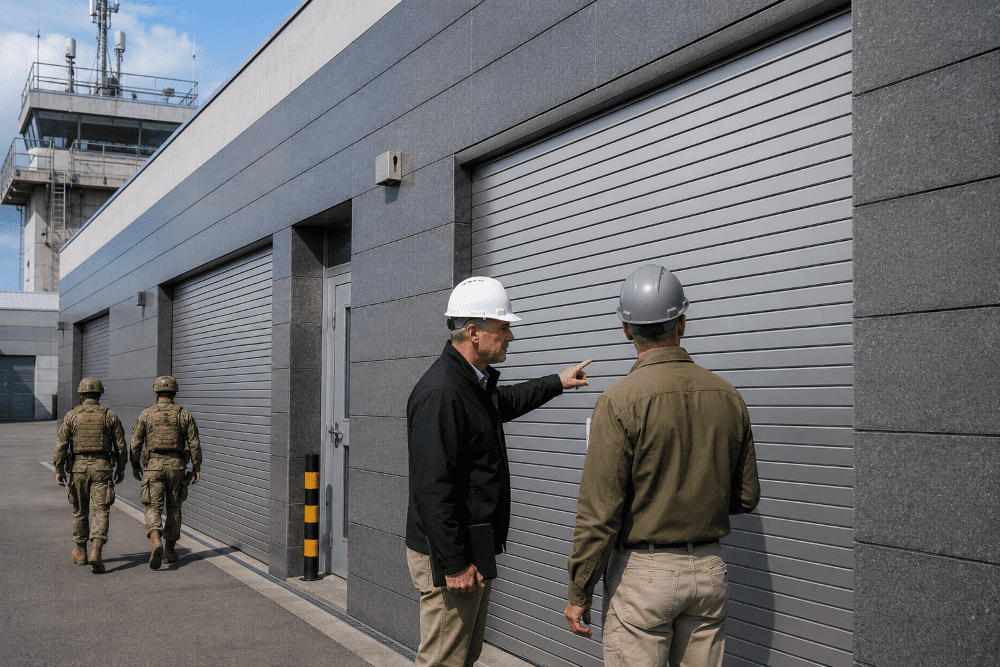
This article covers the threat categories relevant to military and government facilities, the European certification standards that govern blast and ballistic resistance in roller shutters, and the CBX Security certified systems that are used in these environments.
The Threat Profile of a Military or Government Facility
Designing protection for a military base or government compound is fundamentally different from designing protection for a commercial building. The threats are more varied, more severe, and more precisely documented. A security consultant working on a diplomatic compound or military installation is not estimating risk — they are working from threat intelligence that specifies the likely attack vectors, the probable explosive yields, and the expected standoff distances.
Three threat categories drive shutter specification for these facilities:
Blast and Explosion
Explosive threats generate two distinct hazards that a shutter must address simultaneously. The first is the overpressure wave — a rapid increase in atmospheric pressure that travels outward from the detonation point and applies enormous force to any surface it encounters. The second is fragmentation — high-velocity debris propelled by the explosion that can penetrate conventional materials and cause severe injury to anyone behind them.
A shutter that resists the pressure wave but allows fragment penetration has failed. A shutter that stops fragments but is blown off its guides by the overpressure has also failed. Blast resistance means addressing both hazards simultaneously, and this is precisely what European standard EN 13123-2:2004 measures.
Ballistic Attack
Small arms fire and rifle fire are threat categories that cannot be addressed by structural reinforcement alone. A facade with a ballistic-resistant wall but a conventional shutter over its opening offers no protection at the opening. Ballistic resistance in roller shutters is governed by EN 1522, which defines classes FB2 through FB7 based on the calibre and energy of the projectile the shutter must resist without penetration and without dangerous spalling on the protected side.
Forced Entry and Sustained Attack
Military and government facilities are also subject to organised forced-entry attempts. EN 1627 defines resistance classes RC2 through RC6 based on attack time, tools used, and applied force. High-security facilities typically require RC4 or RC5 as a minimum for critical openings.
European Standards for Blast Resistant Shutters
Specifying blast and ballistic protection correctly requires understanding what each standard actually measures. These are not interchangeable certifications — each addresses a different threat, and a product can hold certification under one standard without meeting the requirements of another.
| Standard | Threat addressed | Classification system | Relevant for |
|---|---|---|---|
| EN 13123-2:2004 | Explosion / blast overpressure and fragmentation | EXR1 to EXR5, with NS (non-spalling) suffix | Military, embassies, critical infrastructure |
| EN 1522 | Ballistic attack (small arms and rifle) | FB2 to FB7 based on projectile calibre and energy | Military, banks, VIP facilities |
| EN 1627 | Forced entry and sustained manual attack | RC2 to RC6 based on attack resistance time | All security-critical openings |
The NS suffix in EN 13123-2 is critical for occupied facilities. NS (non-spalling) means that when the shutter is subjected to the blast test, no dangerous fragments are projected into the protected space. A shutter without NS certification may survive the overpressure wave while sending lethal debris into the building interior. For any occupied military or government facility, NS certification is not optional — it is the minimum acceptable standard.
EXR Classification Under EN 13123-2: What the Classes Mean
EN 13123-2:2004 defines five explosion resistance classes for roller shutters. Each class corresponds to a progressively more severe blast test conducted under controlled laboratory conditions. Understanding these classes is essential for matching the product specification to the documented threat profile of the facility.
| Class | Blast severity | Typical application |
|---|---|---|
| EXR1 | Low blast exposure | Commercial buildings in low-threat environments |
| EXR2 | Medium-low blast exposure | Government offices in medium-risk locations |
| EXR3 | Medium blast exposure | Critical infrastructure, financial institutions |
| EXR4 | High blast exposure | High-risk government and diplomatic buildings |
| EXR5 | Maximum blast exposure | Military facilities, embassies in extreme-threat environments |
EXR5 is the highest class defined under EN 13123-2. It is the specification required for facilities operating in extreme threat environments, including forward operating bases, high-value government compounds, and diplomatic missions in conflict-affected regions.
CBX Security Certified Systems for Military Applications
CBX Security manufactures a range of certified high-security roller shutters for military and government facility applications. Each product is designed for integration into hardened facade specifications and is available with full certification documentation for project submission and regulatory compliance.
Diamond BL X-TREME — EXR5-NS Certified
The Diamond BL X-TREME is the most capable blast resistant roller shutter in the CBX Security range — and, as of the date of this publication, the only roller shutter in the world certified to EXR5-NS under EN 13123-2:2004.
This is not a marketing claim. EXR5-NS is the highest classification achievable under EN 13123-2, combining maximum blast resistance with non-spalling performance. The certification was obtained through accredited laboratory testing under the full requirements of the standard. No other manufacturer currently holds this certification for a roller shutter product.
For military facility specifications requiring maximum explosion resistance with documented fragmentation protection in occupied spaces, the Diamond BL X-TREME is the only certified option available on the market.
Diamond BL — Ballistic and Blast Certified
The Diamond BL provides certified ballistic resistance under EN 1522 and blast resistance under EN 13123-2 at EXR4 level. It is the specification of choice for military support facilities, government administration buildings, and hardened perimeter enclosures where EXR5 is not required but multi-threat protection is mandatory.
The Diamond BL also holds certification under EN 1627, providing simultaneous forced-entry resistance at RC class alongside its ballistic and blast protection. This multi-certification capability is essential in facilities where the threat profile includes both explosive attack and organised forced-entry attempts.
SECURBAIX — Reinforced Security Shutter
The SECURBAIX provides certified resistance at RC4 under EN 1627 and is designed for secondary access points, perimeter enclosures, and interior security zones within military and government facilities where blast resistance is not required but forced-entry resistance must meet high-security standards.
Operational Requirements in Military and Government Facilities
Blast and ballistic certification defines minimum protection levels. But military and government facilities have operational requirements that go beyond what a test certificate measures. A shutter that cannot be operated quickly under power failure conditions, or that cannot be integrated with the facility’s access control and alarm systems, creates operational gaps regardless of its certified protection class.
CBX Security shutter systems are designed with these operational constraints in mind:
- Emergency manual operation: All Diamond series shutters include manual override capability for operation under power failure or emergency conditions.
- Building management integration: Systems are compatible with standard BMS and access control protocols for centralised control of all facade closures.
- Architectural integration: Shutter dimensions and housing configurations are available to suit integration into new-build hardened facades and retrofit applications in existing structures.
- Guide and locking systems: Reinforced guide profiles and multi-point locking mechanisms designed to resist the forces generated by blast overpressure without guide separation.
Specifying Blast Resistant Shutters for a Military or Government Project
A complete shutter specification for a military or government facility must address four elements: the threat category, the required protection class for each threat, the operational requirements of the installation, and the certification documentation required for project submission and compliance review.
For projects where the threat profile has been assessed by a security consultant and specific EXR, FB, or RC classes have been identified, CBX Security provides direct technical consultation to map the threat profile to the appropriate certified product from the Diamond series range. Certification documentation, test reports, and installation specifications are available for each product and can be provided in the formats required by European procurement and compliance processes.
For projects where the threat assessment is ongoing, CBX Security can provide technical input on the implications of different EXR and FB specification levels for the product selection and installation requirements of each facade zone.
For further reference on the European standards governing blast and ballistic resistance in building elements, official documentation is maintained through CEN — the European Committee for Standardisation.
Contact CBX Security to request certification documentation, technical datasheets, and project consultation for military and government facility specifications.