
An embassy is not an office building with better locks. It is a facility that operates under a documented threat profile — one that includes ballistic attack, explosive devices, and sustained forced entry — and where the facade is the first and most critical line of defence. When an opening in that facade is unprotected or under-specified, the entire security strategy of the building is only as strong as its weakest point.
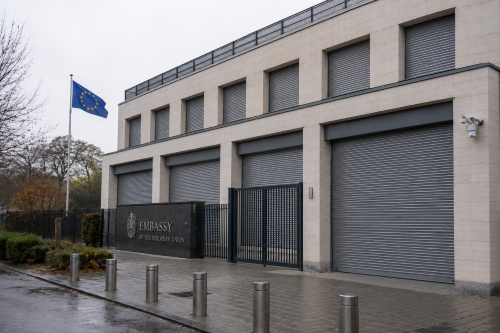
Security shutters for embassies are primary hardening elements, not supplementary measures. Correctly specified, they protect large facade openings — windows, vehicle bays, service entrances — against the full range of threats that diplomatic premises face. Incorrectly specified, they create a false sense of protection that fails precisely when it is tested.
This article is written for architects, security consultants, and project managers working on diplomatic and government facilities in Europe, the GCC, and internationally. It covers which threats drive embassy shutter specification, which European standards apply to each threat category, and which CBX Security certified systems address the requirements of high-risk diplomatic compounds.
Why Embassy Buildings Require a Different Approach to Facade Protection
Most buildings require protection against one threat category at a time. A bank branch needs forced-entry resistance. A private residence needs burglar deterrence. A data centre needs access control. Embassy buildings are different: they face multiple simultaneous, credible threat scenarios, all of which must be addressed at the same facade element.
The three primary threat categories relevant to diplomatic facility specification are:
- Ballistic attack — small arms fire from outside the perimeter, ranging from handgun calibres to high-powered rifle ammunition, including armour-piercing rounds at high-risk posts
- Blast and explosion — vehicle-borne IEDs, parcel devices, and stand-off detonations, which generate pressure waves that load the entire facade simultaneously rather than at a single impact point
- Forced entry — sustained manual attack using mechanical tools, crowbars, and high-powered drilling equipment, relevant at access points, vehicle gates, and service entrances
Each of these threats is governed by a separate European certification standard. A product certified for ballistic resistance is not automatically certified for blast resistance. A shutter that holds against a sustained tool attack may offer no meaningful protection against a pressure wave. The specifications must be verified independently for each threat category — and the product must hold documented third-party certification for each one that applies to the zone being protected.
The European Standards That Govern Embassy Shutter Specification
When a security consultant or architect specifies a shutter for a diplomatic facility, the reference framework is always the European standard for the relevant threat. The three standards that apply to embassy facade openings are:
EN 1522 / EN 1523 — Ballistic Resistance
This standard classifies bullet resistance of windows, doors, shutters, and blinds into seven classes from FB2 to FB7, based on calibre, ammunition type, and velocity. FB4 represents the baseline for personal protection environments. FB6 and FB7 cover military-grade threats and armour-piercing ammunition. The suffix NS (No Spall) indicates that no hazardous fragments are generated on the protected side during the test — a critical requirement for occupied buildings, where interior fragmentation from a stopped round would itself cause casualties.
EN 13123-2:2004 — Blast and Explosion Resistance
This standard classifies outdoor detonation resistance from EXR1 to EXR5, tested by detonating a measured TNT charge at a defined distance from the element in open-field conditions. The classification is based on the peak reflected pressure and positive impulse that the element withstands without penetration or hazardous fragmentation on the protected side.
| Class | TNT Equivalent | Stand-off Distance | Peak Pressure |
|---|---|---|---|
| EXR1 | 3 kg | 5 m | 2.5 bar |
| EXR2 | 3 kg | 3 m | 8 bar |
| EXR3 | 12 kg | 5.5 m | 7 bar |
| EXR4 | 12 kg | 4 m | 16 bar |
| EXR5 | 20 kg | 4 m | 28 bar |
Source: EN 13123-2:2004 / EN 13124-2:2004 classification table. EXR5 is the maximum certified class under this standard.
EN 1627 — Resistance to Forced Entry
This standard classifies burglar resistance from RC2 to RC6 based on the tools used and the duration of sustained attack. RC4 represents serious tool attack. RC6 — the maximum — covers high-powered drilling and sawing equipment applied for over ten minutes. For embassy access points, service gates, and vehicle bays, RC4 minimum is the typical baseline; RC6 applies to the highest-risk perimeter positions.
Security Shutters for Embassies: Matching Protection Level to Building Zone
Not every zone of a diplomatic compound requires the same protection level. The specification goal is to match each certified element to the actual threat profile of each facade zone — neither under-protecting high-risk positions nor over-specifying areas where the threat level does not justify it. The following framework reflects standard practice in diplomatic facility security programming:
| Facade Zone | Primary Threats | Required Certifications | Recommended CBX Product |
|---|---|---|---|
| Public-facing facade, street level | Blast + ballistic + forced entry | EXR5-NS + FB6-NS + RC6 | Diamond BL X-TREME |
| Secondary facade, courtyard | Ballistic + forced entry | FB4-NS + RC4 | Diamond BL |
| Chancellery and archive zones | Ballistic + fire containment | FB4-NS + EN 1634 EI60 | Diamond BL + EPSILON |
| Vehicle access and service gates | Forced entry + blast | RC4 + EXR3 minimum | SECURBAIX |
This table is a starting framework. Every project requires a site-specific threat assessment before finalising protection class selection. A mission with no vehicular setback in a dense urban environment faces a materially different blast scenario than a compound with a 30-metre perimeter buffer.
The Diamond BL X-TREME: The Only EXR5-NS Certified Roller Shutter in the World
When architects and security consultants begin searching for a blast-rated roller shutter for a high-risk embassy facade, they encounter a consistent market gap: blast-rated doors exist, blast-rated glazing systems exist, but roller shutters — the elements needed to protect large openings such as vehicle bays and oversized windows — have historically been impossible to certify at EXR5 level. The construction geometry of a coiling shutter does not naturally absorb a 28-bar pressure wave.
The Diamond BL X-TREME is the only roller shutter in the world that has resolved this engineering problem and holds a certified result.
The Diamond BL X-TREME BLAST holds EXR5-NS certification under EN 13123-2:2004, obtained through outdoor detonation testing — not shock tube simulation. This means the test conditions replicate a real-world explosive event: a measured charge detonated in open field conditions, with the element tested in its actual installed configuration including frame, anchoring system, and all hardware.
The Diamond BL X-TREME MAX — the most comprehensive version — combines five independent certified protections in a single element:
- RC6 burglar resistance — EN 1627:2011
- FB6-NS ballistic protection — EN 1522:1999
- EXR5-NS blast protection — EN 13123-2:2004
- E60 fire resistance — EN 13501-1:2019
- C5 wind resistance — EN 12424:2000
No other roller shutter manufacturer currently holds simultaneous third-party certification across all five of these categories. For a specifier trying to address the full protection matrix of a high-risk embassy facade with a single certified element rather than layering separate systems for each threat, this is the only available solution in the European market.
All models include motorised automation and can be integrated into building management systems, allowing the entire compound to be secured within seconds from a central control point — a critical operational requirement for diplomatic facilities that must respond rapidly to a threat escalation.
What to Verify Before Accepting a Certification Claim
The word “certified” is used loosely in the security products industry. For diplomatic facility specification, it has a precise meaning: the product was tested in its installed configuration by an accredited third-party laboratory, and the results were formally classified under the relevant European standard. It does not mean the manufacturer’s own assessment, and it does not mean a product is “equivalent” to a tested configuration.
Before accepting any certification claim from a supplier, verify the following:
- Request the original test report, not a summary sheet or a certificate image. The test report specifies the exact product configuration tested — slat profile, frame dimensions, anchoring method, installation configuration.
- Check the NS suffix on both ballistic and blast certifications. A product that stops ballistic or blast loads but generates interior fragmentation does not provide safe protection for occupied buildings.
- Verify the installation match. Certification applies only to the tested configuration. If the product will be installed differently — different frame size, different anchoring method, different substrate — the certification may not apply to your specific installation.
- Confirm each standard independently. Blast certification and ballistic certification are separate. A supplier presenting one does not imply the other.
CBX Security provides complete original certification documentation for all products referenced in this article. Technical datasheets, test reports, and installation specifications are available on request for each project.
Specifying CBX Security Shutters for Diplomatic and Government Projects
CBX Security works directly with architects, facade engineers, security consultants, and government procurement teams on diplomatic and government facility projects across Europe, the GCC, and internationally. All products in the Diamond series are available with full certification documentation, project-specific technical consultation, and integration support for building management and access control systems.
For projects specifying security shutters for embassies, government buildings, military facilities, or critical infrastructure, CBX Security provides threat-mapped product recommendations based on the specific protection requirements of each facade zone.
For further technical reference on European blast resistance standards, the official EN 13123-2:2004 documentation is maintained through national standardisation bodies including CEN member organisations across Europe.
Contact CBX Security to request certification documentation and technical specifications for your project.