
Banks, embassies and public-access buildings share a requirement that few security solutions meet simultaneously: visual openness and operational transparency at the perimeter, combined with verified ballistic resistance. A standard glass door does not meet that requirement. An opaque door meets it only halfway. Bulletproof glass doors certified to EN 1522 resolve both demands without compromise.
This article covers the technical selection criteria, applicable protection levels by facility type, and architectural integration requirements that affect project specification.
Why bulletproof glass is not a technical contradiction
 Ballistic security glass is a laminated assembly of glass layers and polymer materials whose impact resistance is determined through standardised testing. European standard EN 1063 classifies glazing by ballistic threat level — P1A to P8B for firearms, BR1 to BR7 in the American equivalent. Standard EN 1522 regulates the ballistic resistance of the complete element — door, frame and anchoring system — as a single unit.
A P6B glazing assembly can withstand multiple assault rifle impacts. Mounted in an inadequate frame, the complete element will fail before the glass does. EN 1522 certification evaluates precisely that functional unit: the door as a system, not the glass as a material.
Protection levels and facility types
Protection level selection must be based on a real threat assessment, not generic criteria. Standard EN 1522 establishes six ballistic resistance classes (FB1 to FB6-NS) based on calibre, velocity and number of impacts the element must withstand without penetration.
| Level | Threat resisted | Typical facilities | CBX product |
|---|---|---|---|
| FB4 | .44 Magnum handgun | Bank branches, pharmacies, jewellery stores | CBX bulletproof glass door |
| FB5 | Winchester rifle, semi-automatic carbine | Cash processing centres, critical infrastructure nodes | CBX bulletproof glass door |
| FB6-NS | AK-47 assault rifle, no splinter projection | Embassies, military facilities, government buildings | CBX-60 / Diamond BL |
The NS suffix (No Splinter) means the element, after receiving an impact, does not project fragments towards the protected interior. For facilities with permanent staff in exposed positions — teller windows, access control points, reception desks — NS certification is an operational requirement, not an option.
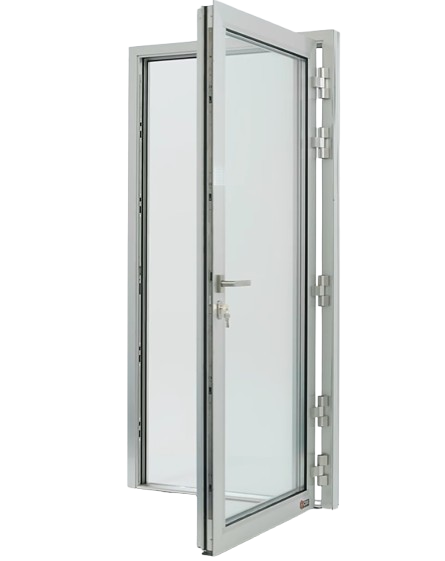
Specification criteria for banking and institutional projects
Security engineers and architects specifying this type of element must verify the following parameters before closing the specification:
System integrity, not just the glass
Certification must cover the complete door assembly: leaf, frame, wall anchoring system and hardware. An FB6-certified leaf mounted on an untested frame does not guarantee the declared protection level. Always request the certificate for the complete element issued by an accredited laboratory.
Complementary RC burglar resistance
At facilities combining physical intrusion risk and ballistic threat, the element must also hold burglar resistance certification to EN 1627. Classes RC3, RC4 or RC6 — depending on the threat level — guarantee resistance to tool attack for the established test duration. Ballistic certification does not imply burglar resistance, and vice versa.
Fire resistance
At evacuation routes or fire compartmentation points, the door may additionally require E30, E60 or E90 classification to EN 1634. Elements combining ballistic resistance and fire resistance in a single assembly are technically complex and significantly narrow the field of certified manufacturers.
Dimensions and structural load
High-resistance laminated glazing has a considerably higher weight per square metre than standard glass. In refurbishment projects, the specification must verify the load capacity of the supporting structure and the compatibility of automation systems with that weight.
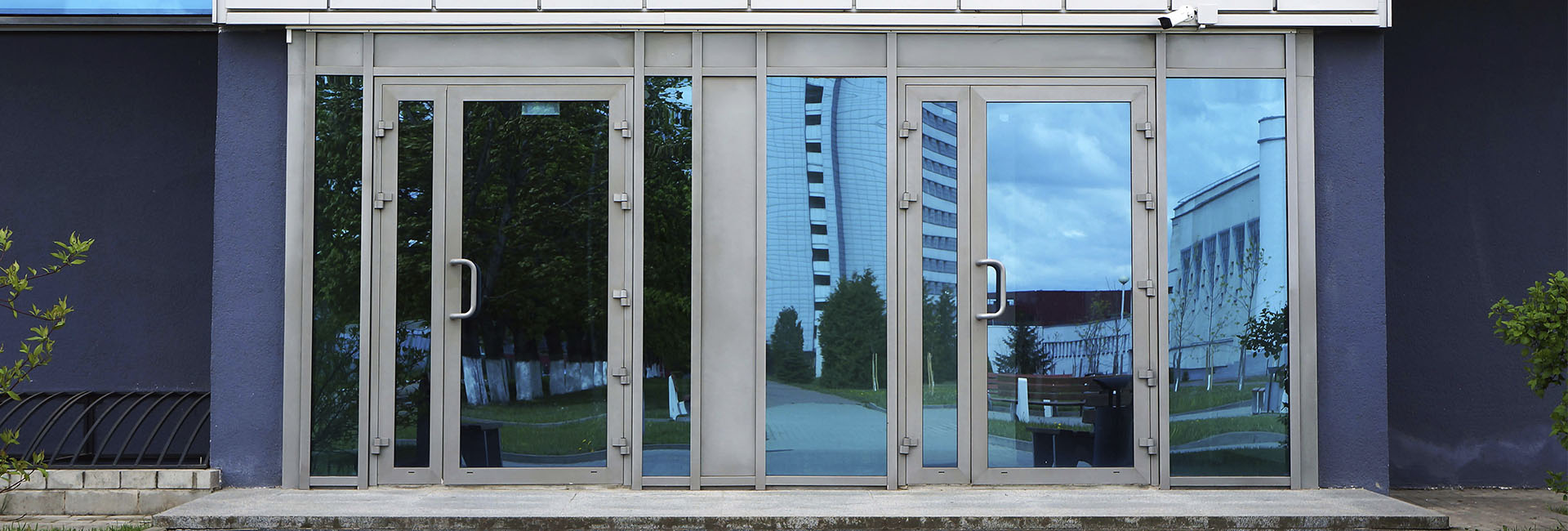
Applications by sector
Financial institutions
Bank branches serving the public require access doors and interior partitions that allow operational visibility without exposing staff to ballistic risk. Teller areas and vault access points have distinct threat profiles and may require different protection levels within the same building.
Embassies and diplomatic missions
Diplomatic security protocols establish minimum ballistic resistance requirements for access points and facades of missions in high-risk areas. The combination of FB6-NS with EXR blast resistance is standard in projects of this type.
Government and public administration buildings
Civil registries, police stations, courts and public administration buildings with citizen-facing services present a mixed risk profile: the need for accessibility and visual openness combined with protection of staff at fixed positions. Bulletproof glass doors manage that duality better than any other perimeter solution.
Data centres and critical infrastructure
Physical access to critical facilities — data centres, telecommunications nodes, electrical substations — requires reinforced access control with ballistic protection at entry points. Integration with electronic access control systems and building automation is a standard requirement for these projects.
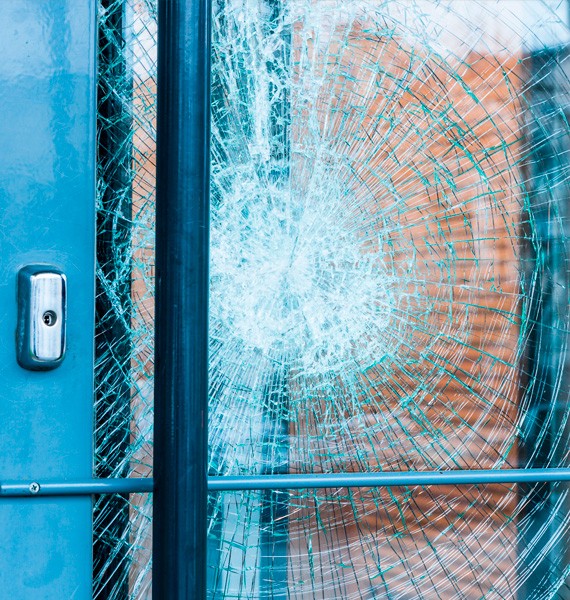
CBX bulletproof glass door — technical data
The CBX Security bulletproof glass door combines in a single element all the certifications required for high-demand institutional and financial projects:
- Ballistic resistance: Certified to EN 1522, level FB4 to FB6-NS depending on configuration
- Burglar resistance: RC2 to RC5 to EN 1627:2011
- Fire resistance: Available with E30 to E90 classification to EN 1634
- Acoustic insulation: Reduction of up to 44 dB(A)
- Thermal insulation: Uw ≥ 1.6 W/m²K
- Wind resistance: Class C5 to EN 12424
- Construction: 1.5 mm galvanised steel frame with internal reinforcements; multi-layer laminated glazing
- Automation: Compatible with access control systems and building automation
- Customisation: Dimensions, finish and opening configuration to project requirements
The element is available as a single or double-leaf door, with hinged or sliding opening configurations depending on project requirements.
For complete technical specifications, downloadable product datasheets and project quote requests, see the product page:
View full technical datasheet — CBX bulletproof glass door
How to request a technical specification for your project
Every installation has specific requirements in terms of protection level, dimensions, integration with other security systems and applicable local regulations. The CBX Security technical team works with architects, security engineers and procurement departments to define the correct specification before issuing a proposal.
To begin the specification process, provide the following information in your enquiry:
- Facility type and country of installation
- Required ballistic protection level or applicable regulatory reference
- Approximate opening dimensions
- Additional requirements: fire resistance, access control, integration with existing systems
The team responds with a preliminary technical specification and indicative budget within 48–72 working hours.