
Fire rated roller shutters are the primary passive fire protection barrier for large openings in industrial, commercial and institutional buildings. When a fire alarm activates, the shutter closes automatically and holds the fire and smoke on one side of the opening — buying time for evacuation and limiting structural damage. This guide covers how EN 1634 classification works, what E30 through E240 means for your project, and when a combined fire and security certification is required.
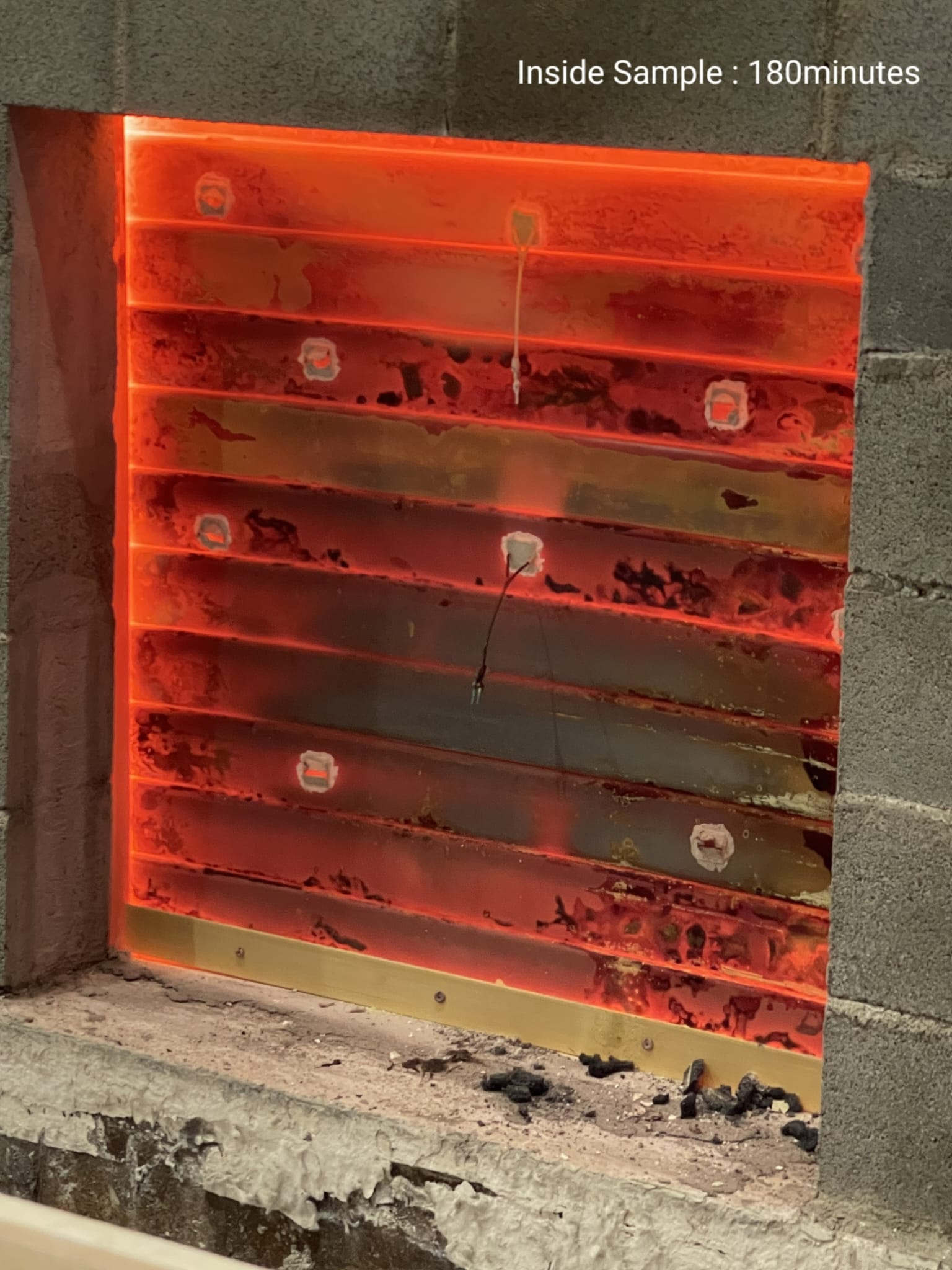
How EN 1634 classifies fire resistance in roller shutters
EN 1634 is the European standard that governs fire resistance testing for doors, shutters and opening protective devices. It defines the test methodology — exposing the element to a standardised fire curve — and the classification system used to communicate results to architects, specifiers and procurement teams.
The E classification refers to integrity: the element’s ability to prevent flames and hot gases from passing through. The EW classification adds radiation control. The EI classification — the most demanding — also limits heat transmission on the protected face. For roller shutters in most commercial and industrial applications, E or EW classification is the relevant specification.
| Classification | Fire resistance duration | Typical application |
|---|---|---|
| E30 | 30 minutes | Internal compartmentation, low-risk areas |
| E60 | 60 minutes | Commercial buildings, office complexes |
| E120 | 120 minutes | Industrial facilities, warehouses, logistics |
| E240 | 240 minutes | High-risk industrial, hospitals, critical infrastructure |
The required classification for a specific opening is determined by the fire compartmentation strategy in the building’s fire safety design — typically specified by the fire engineer or set by local building regulations. In the UK, Approved Document B sets minimum standards. In France, the Règlement de Sécurité contre l’Incendie applies. For industrial sites classified as SEVESO or equivalent, E120 or E240 is typically the minimum.
Automatic activation: how fire shutters respond to an alarm
A fire rated roller shutter must close reliably when it matters. Standard configurations use one or more of the following trigger mechanisms:
Fusible link: A thermal fuse that melts at a set temperature, releasing the shutter to close under gravity or spring tension. Simple, reliable, no power required. Standard in most installations.
Smoke and heat detector integration: The shutter is wired into the building’s fire detection system and closes on signal. Allows earlier response before temperature thresholds are reached.
Manual release: A local release station allows personnel to close the shutter independently of the alarm system. Required in many national regulations as a backup mechanism.
Fail-safe closure: Certified fire shutters are required to close on power failure — they cannot depend on powered closure mechanisms for their fire protection function. Spring or gravity closure with electromagnetic hold-open is the standard configuration.
When combined fire and security certification is required
Standard fire shutters are not designed to resist forced entry or ballistic attack. For facilities where both threats are present — industrial sites in high-crime areas, government buildings, data centres, airports — a combined certification is required.
A shutter specified only to E240 will stop a fire. It will not stop a determined intruder with cutting tools. A shutter specified only to RC4 under EN 1627 will resist a ten-minute forced entry attempt. It will not contain a fire.
The relevant combined specifications are:
- EN 1634 + EN 1627: Fire resistance combined with anti-intrusion resistance. Available in configurations from E30/RC3 up to E240/RC4 depending on the manufacturer and element design.
- EN 1634 + EN 1522: Fire resistance combined with ballistic resistance. Required for facilities under armed threat where fire compartmentation is also mandated.
- EN 1634 + EN 13123: Fire resistance combined with blast resistance. Specified for high-risk government and military facilities.
Each certification must be independently verified by an accredited laboratory. A manufacturer claiming combined performance without independent test evidence for each standard is not providing certified combined protection.
CBX Security Epsilon — fire rated roller shutters certified to E240
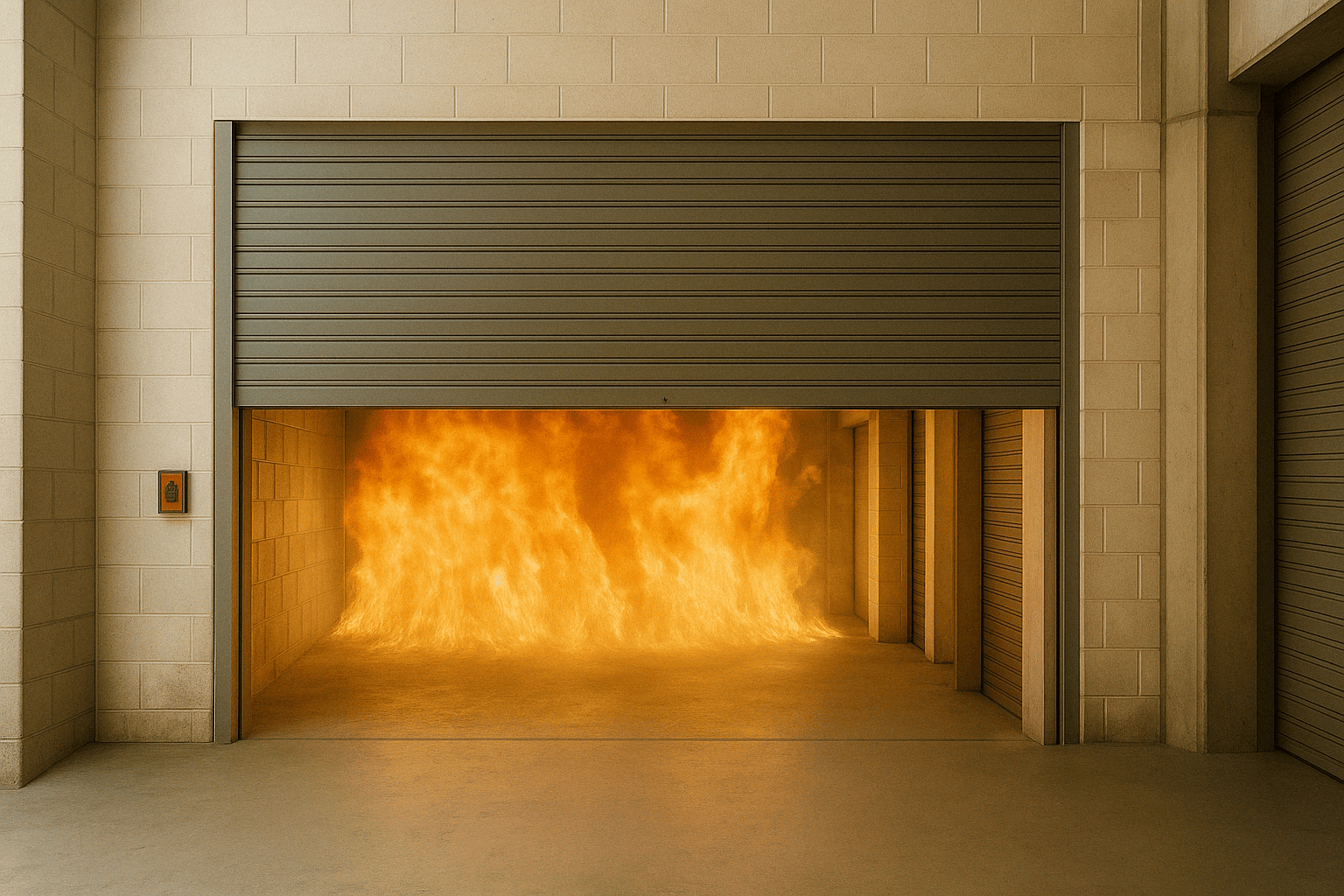
The CBX Security Epsilon series is certified to EN 1634 across the full range from E30 to E240. It is designed for industrial, commercial and institutional applications where large openings require reliable fire compartmentation without compromising operational throughput during normal use.
Key specification data for the Epsilon series:
- Fire classification: E30 / E60 / E120 / E240 under EN 1634-1
- Construction: Galvanised steel slats with intumescent seals — the seals expand under heat to close gaps between slats and frame
- Activation: Fusible link, smoke detector integration, and manual release as standard
- Closure mechanism: Spring-assisted gravity closure — fails safe on power loss
- Maximum dimensions: Up to 8 000 mm wide and 6 000 mm high depending on configuration
- Finishes: RAL colour range, stainless steel option available
- Certification body: Independently tested and certified — test reports available on request
The Epsilon is available in a version that combines E60 fire resistance with RC3 anti-intrusion resistance under EN 1627, for facilities requiring both passive fire protection and resistance to opportunistic forced entry.
Frequently asked questions
What is the difference between E30 and E240 fire rated shutters?
E30 means the shutter maintains integrity for 30 minutes under standard fire test conditions. E240 maintains integrity for 240 minutes — four hours. The required classification depends on the building’s fire compartmentation design and the relevant national building regulations.
Do fire rated roller shutters need maintenance?
Yes. EN 1634 certified shutters must be maintained to retain their classification in use. Minimum requirements include annual inspection of the release mechanism, intumescent seals, guide rails and closure test. The maintenance schedule should be documented and available for building inspections.
Can a fire shutter also provide security against forced entry?
A standard fire shutter is not designed for anti-intrusion resistance. Combined fire and security performance requires a product certified independently to both EN 1634 and EN 1627. CBX Security offers combined Epsilon configurations for this requirement.
What is the maximum size for a fire rated roller shutter?
CBX Security Epsilon shutters are available up to 8 000 mm wide and 6 000 mm high. Larger openings may require a structural assessment and are evaluated on a project basis. Contact our technical team with your opening dimensions for a project-specific assessment.
If you are specifying fire rated roller shutters for an industrial facility, commercial building or critical infrastructure project, CBX Security provides certified product documentation, test reports and project-specific technical support. Contact our technical team to request a consultation or download the Epsilon specification sheet.