
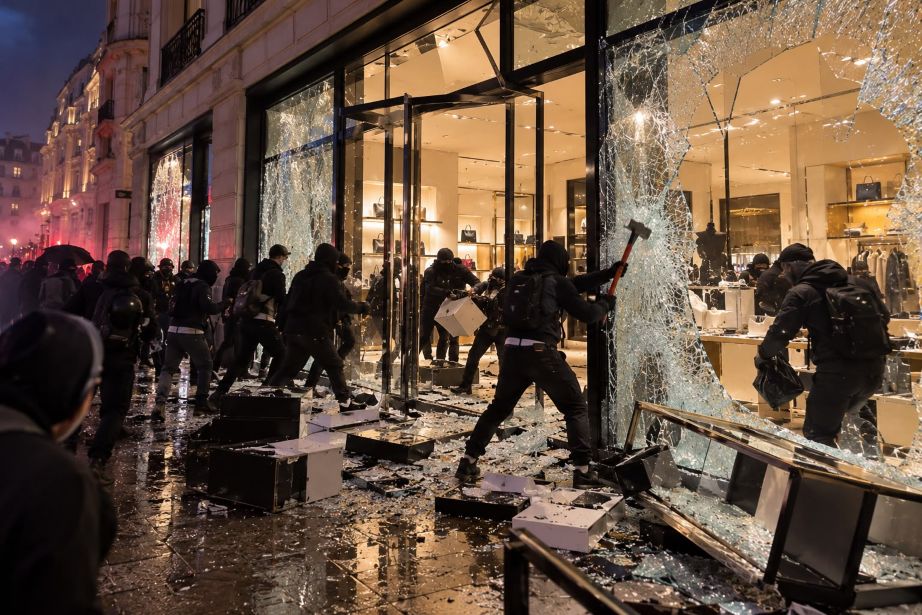
Smashed storefronts. Broken glazing. Shelves emptied in minutes. The scenes that follow riots, civil unrest, and organised smash-and-grab raids have one thing in common: the perimeter offered no resistance. A standard shop front – glass door, aluminium frame, basic rolling shutter – does not delay a determined attacker. It stops nobody.
This article covers what actually separates a decorative shutter from a certified anti-vandalism barrier, which resistance class applies to which threat level, and what retailers and property managers need to verify before specifying any perimeter protection.
Why civil unrest is now a retail security planning variable
Organised looting and vandalism during periods of civil unrest has accelerated a change in how retail security is specified. The traditional model – CCTV, alarm, basic shutter – was designed to deter opportunistic theft and buy time for police response. It was not designed for coordinated attacks involving multiple people, improvised tools, and a response window measured in minutes rather than hours.
The difference between a store that reopens the next morning and one that sustains six-figure losses is, in most documented cases, the resistance class of the perimeter element. Not the alarm. Not the camera. The physical barrier.
This is the logic behind the European standard EN 1627, which defines exactly how long a certified element must resist a given attack method before an intruder can gain access.
What EN 1627 resistance classes actually mean for retail
The EN 1627 standard classifies doors, windows, and shutters from RC1 to RC6 based on their resistance to physical attack with progressively more powerful tools. The classification is not based on materials alone – it is based on tested performance of the complete assembled unit: shutter, guides, locking system, and anchorage to the building structure.
For retail applications, the relevant classes are RC3 through RC6:
| Class | Attacker profile | Tools used in testing | Typical retail application |
|---|---|---|---|
| RC3 | Experienced attacker with crowbars and hammers | Second lever, chisel hammer | High-street retail, pharmacies, electronics stores |
| RC4 | Experienced attacker with power tools | Angle grinder, circular saw, drill | Jewellery stores, watch retailers, currency exchange |
| RC5 | Organised group with high-power cutting equipment | High-power saws, sustained cutting | Precious metals, high-value goods distribution |
| RC6 | Organised attack with maximum-power tools | Maximum-power tools, prolonged attack | Vaults, critical storage, institutional perimeters |
The resistance class determines how long the element holds under sustained attack – long enough to make the intrusion operationally unviable. An attacker who cannot gain access within a defined window is, in practice, defeated by the shutter.
The specific threat: smash-and-grab and riot-driven looting
Smash-and-grab attacks and riot looting share a defining characteristic: speed. Attackers rely on rapid access through minimal resistance, extraction of high-value items, and exit before any response arrives. The attack window is typically two to five minutes.
An RC3-certified shutter converts that window into an obstacle. An RC4 shutter makes the attack operationally irrational – the time required to breach the element exceeds the safe window for the attacker. The majority of smash-and-grab events documented in urban retail environments involve storefronts that offered no certified resistance: standard glazing, lightweight aluminium frames, or shutters with no resistance class certification.
What vandalism does that burglary alone does not
Vandalism in the context of civil unrest is not purely about theft. The objective is often destruction: broken glazing, structural damage to frames, damage to interior fittings and stock that cannot be attributed to the items taken. Insurance claims following riot-driven vandalism routinely exceed the value of stolen goods by a factor of three to five, because the structural damage to the premises requires specialist repair before the store can reopen.
A certified security shutter eliminates the structural damage vector entirely. If the element is not breached, the interior of the premises is not touched.
What a certified installation actually requires
Certification of the complete unit, not just the shutter blade
The resistance class certification must cover the entire assembled element: the shutter blade, the guides, the locking mechanism, and the anchorage system to the building structure. A certified blade installed on uncertified guides with inadequate fixing to the wall does not provide the declared resistance class. Request the certificate for the complete assembly, issued by an accredited laboratory, before accepting any installation.
Installation methodology matching test conditions
EN 1627 testing is performed on elements installed under specific conditions. The installation methodology must replicate those conditions – anchorage depth, fixing pattern, guide specification – to maintain the certified resistance. An installer who deviates from the tested configuration invalidates the certification in practice, regardless of what the paperwork states.
Structural adequacy of the opening
Higher resistance class shutters generate higher loads on the surrounding structure during an attack. RC4 and above installations require verification that the wall or facade element receiving the guides and head box can absorb those loads without failure. In retrofit applications on older buildings, structural assessment is a prerequisite to specification.
CBX Security anti-vandalism shutters – certified resistance RC3 to RC6
CBX Security manufactures and installs anti-vandalism and anti-burglary roller shutters certified to EN 1627 across resistance classes RC3, RC4, RC5, and RC6. All units are independently tested and certified – not self-declared. The certification covers the complete assembled element including guides, locking system, and specified anchorage.
- Resistance certification: EN 1627:2011, classes RC3 to RC6
- Visibility options: Solid slat and perforated configurations available at all resistance classes
- Automation: Compatible with access control systems and building automation
- Material: Extruded aluminium with internal reinforcement
- Customisation: Dimensions, finish, and opening configuration to project specification
- Installation: Factory-certified installation teams; methodology documented for each project
The SECURBAIX line covers RC3 and RC4 applications, suited to the majority of retail and commercial premises. The DIAMOND BL line extends to RC6, with additional certification options including ballistic resistance (EN 1522, FB6-NS) and explosion resistance (EN 13123, EXR5-NS) for installations with compound threat profiles.
View SECURBAIX RC3–RC4 product page
How to specify the right resistance class for your premises
Resistance class selection depends on three variables: the assessed threat profile of the location, the value and replaceability of the goods or assets protected, and any minimum requirements imposed by insurers or sector regulation.
For most urban retail premises in locations with documented exposure to civil unrest or organised retail crime, RC4 represents the practical baseline. It defeats the tool set used in the majority of documented smash-and-grab attacks. RC3 is appropriate for lower-exposure locations where the primary threat is opportunistic intrusion. RC5 and RC6 apply where the asset value justifies the cost of extended resistance and where the attacker profile includes organised groups with industrial tools.
To initiate a technical specification for your premises, provide the following information:
- Type of premises and country of installation
- Approximate opening dimensions
- Current perimeter configuration (existing shutter, glazed frontage, other)
- Any insurer-specified minimum resistance class
- Visibility requirements when closed
The CBX Security technical team responds with a preliminary specification and indicative budget within 48 to 72 working hours.