
Data Center Physical Security: Why the Door Is the Last Line That Cannot Fail
A data center can have the most sophisticated firewall architecture, redundant power systems, and 24/7 monitoring — and still be compromised in under three minutes by someone who walks through the wrong door. Physical security in critical infrastructure is not a checkbox. It is the layer that every other layer depends on.This article covers what physical protection actually means in a data center environment, where conventional doors and shutters fall short, and what certified solutions look like in practice.
The Threat Profile Is Different Here
Most commercial buildings need to keep opportunistic intruders out. Data centers face a different threat profile. The people who want to access a data center without authorization are often not opportunistic — they are targeted. They know what they are looking for, they have tools, and they have time if the physical barriers are weak enough.At the same time, data centers carry a fire risk that most other buildings do not. Dense electrical infrastructure, continuous heat generation, and uninterrupted operation requirements mean that a fire event is not just a safety incident — it is a potential total-loss scenario for the business that depends on that facility. The combination of forced intrusion risk and high fire risk means that doors and shutters in a data center need to address both threats simultaneously, and they need to do it without disrupting daily operations.
Where Conventional Security Fails
Standard commercial security doors are tested for opportunistic intrusion — a crowbar, a kick, a basic drilling attempt. They are not designed to withstand a professional forced entry using power tools, which is the relevant threat for a facility that houses valuable hardware or sensitive data. RC4 and RC5 classification under EN 1627 means the door has been tested against exactly that scenario: sustained attack with angle grinders, drills, and wedging tools under laboratory conditions with a defined time resistance.
Standard fire shutters, on the other hand, are designed to contain fire spread. They close on alarm and hold for a rated period. What they are not designed to do is resist a simultaneous intrusion attempt. In a data center, a fire event creates exactly the kind of operational disruption that a targeted attacker might exploit — alarms trigger, personnel evacuate, access control systems may enter fail-open mode. A shutter that stops fire but can be forced open manually in that window is not adequate protection.
What Certified Physical Protection Looks Like
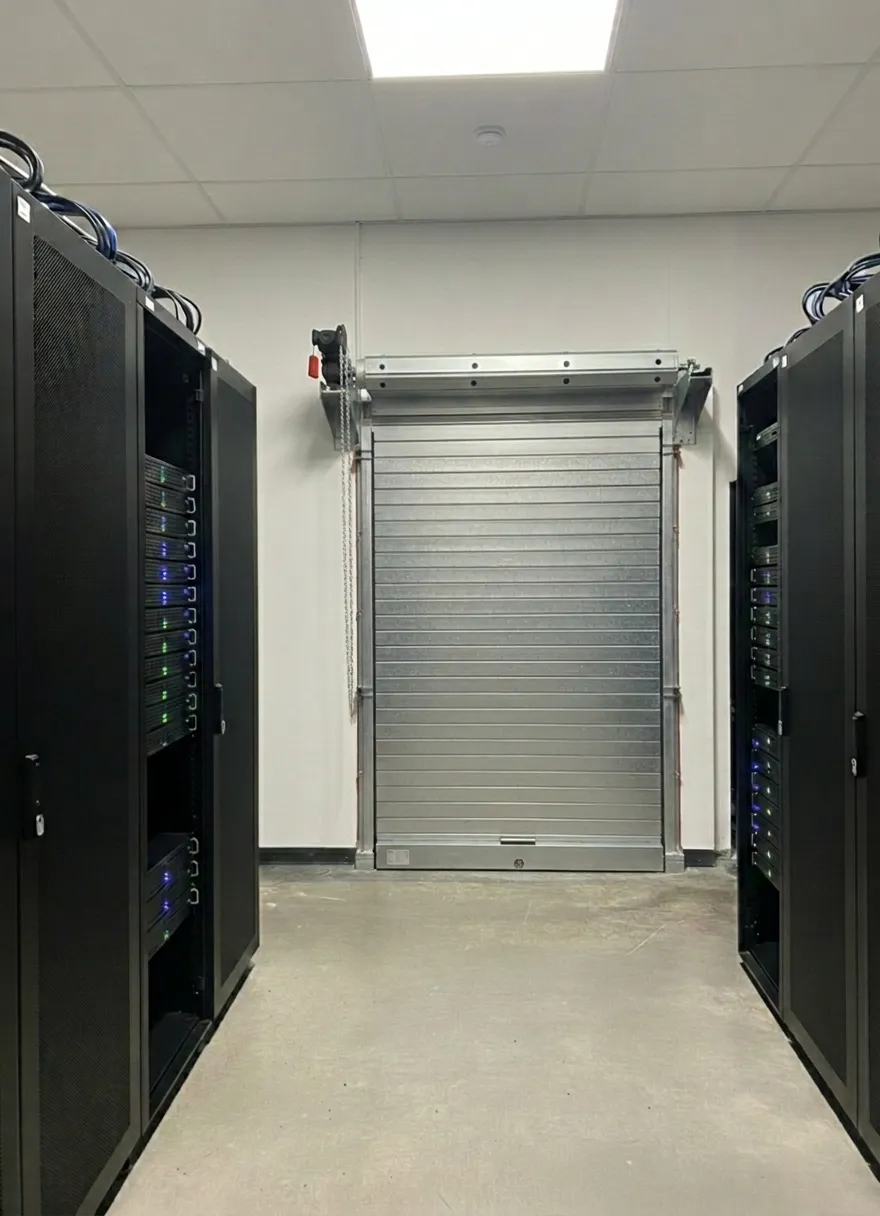
The EPSILON rolling door from CBX Security was developed for environments where fire resistance and physical security are not separate requirements. It carries certification for both fire containment and resistance to forced entry, and it operates automatically on alarm integration — meaning it responds to the building management system without requiring manual intervention. For server rooms, electrical rooms, and UPS areas inside a data center, this means the access point closes and holds under both threat scenarios. You can find full technical specifications for the [EPSILON fire and explosion-resistant rolling door here →].
For main access points, loading areas, and perimeter entries where the primary risk is forced intrusion rather than fire, CBX armored doors certified to RC4 under EN 1627 provide resistance against professional attack tools. RC4 means the door has been tested to resist a sustained attack with power tools for a defined period — not just a impact or a kick. These doors integrate with electronic access control, biometric readers, and alarm systems, and they are manufactured to custom dimensions for the specific opening.
Zoning: Why One Door Type Is Not Enough
A data center is not a single room with a single entry point. It is a layered environment: a perimeter entry, a reception or security checkpoint, a server hall, individual cage or cabinet areas, electrical infrastructure rooms, and cooling plant. Each zone has a different risk profile and a different regulatory requirement.
The perimeter entry needs to handle high traffic while maintaining intrusion resistance. Server rooms need fire containment combined with access restriction. Electrical and UPS rooms carry the highest fire risk and typically require automatic closure systems that trigger independently of whether anyone is present. Applying the same door to all of these zones is both technically incorrect and a compliance risk in jurisdictions where data center physical security is regulated or audited.
CBX works with data center operators and their architects during the specification phase to map door and shutter requirements zone by zone, ensuring that each opening carries the appropriate certification for its risk profile and integrates with the existing access control and BMS infrastructure.
Integration With Building Systems
Physical barriers only function as part of a security system if they communicate with that system. A high-security door that cannot signal its status to a monitoring platform, or a fire shutter that cannot receive a trigger from the building management system, creates gaps that undermine the overall architecture.
CBX doors and shutters are designed for integration with access control systems, alarm platforms, and BMS. This means door status — open, closed, forced, held open — is visible in the monitoring environment, and automated responses such as lockout or emergency closure can be triggered by system events rather than requiring manual action. In a data center where staffing levels outside business hours may be minimal, this kind of integration is not optional — it is what makes the physical security layer functional.
The Specification Decision
Physical security for a data center is a specification decision, not a procurement decision. The difference matters because the right solution depends on the specific dimensions of each opening, the risk classification of each zone, the regulatory environment the facility operates in, and the integration requirements of the existing systems. A door that meets RC4 in one configuration may not meet it in another if the frame, anchoring, or installation does not match the tested assembly.
CBX provides technical support during the planning and specification phase, working directly with architects, security consultants, and facility managers to ensure that what is specified can be installed and certified correctly. If you are specifying physical security for a data center project, the starting point is a zone-by-zone review of access points and their risk and compliance requirements.