
In environments where operational continuity cannot compromise, fire protection transcends regulatory compliance to become an institutional survival imperative. Facilities managing critical assets—from bank vaults to data centers—face a unique technical challenge: how to protect large openings without sacrificing operational functionality or safety standards.
The Critical Factor in Fire Compartmentalization
A fire rated roller shutter represents the convergence of passive protection engineering and industrial operability. Unlike fixed barriers, these systems must simultaneously fulfill three functions: allow vehicle access during normal operations, activate automatically in emergencies, and contain fire and smoke for prolonged periods under extreme heat conditions.
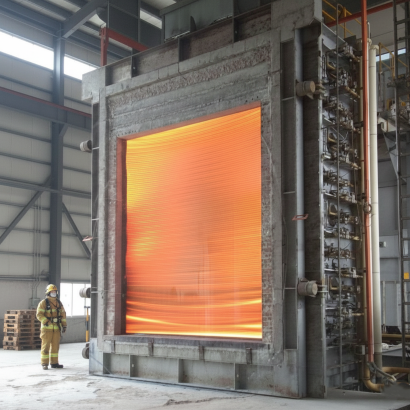
Fires in industrial facilities progress exponentially. In the first ten minutes, temperatures can reach 800°C, at which point conventional structural steel loses up to 50% of its load-bearing capacity. A roller shutter certified under EN 1634 must maintain its structural integrity, prevent the passage of flames, and, in advanced configurations, limit thermal transfer to the non-exposed side.
Resistance Engineering: Beyond Regulatory Compliance
Certifications E30, E60, E120 up to E240 are not merely numbers on a plate. They represent validation through real-scale fire tests where the entire system—lamellas, guides, closing mechanisms, anchors—must withstand direct exposure to standardized temperature curves. An E120 system, for instance, guarantees two hours of containment, critical time for evacuation, emergency response, and asset safeguarding.
The technical complexity increases in facilities that require multifaceted protection. Imagine a petrochemical facility where fire risks converge, perimeter security requirements, and exposure to aggressive environmental conditions. The design must integrate fire resistance with intrusion protection, corrosion resistance, and continuous operational capability in environments with extreme temperatures and exposure to chemical agents.
Integrated Systems: When Security is Holistic
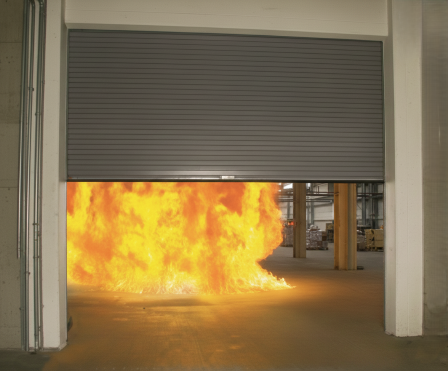 The true differentiation in the protection of critical infrastructures emerges when systems combine multiple certifications. A shutter that integrates fire resistance (EN 1634), ballistic protection (EN 1522), and resistance to break-in (EN 1627) eliminates vulnerabilities in physical security design.
Consider a Tier IV data processing center: the main opening must allow access for large maintenance equipment, withstand physical intrusion attempts, and guarantee fire compartmentalization that protects critical systems long enough for response protocols to activate. An E180 certified roller shutter system provides three hours of barrier against fire spread, while integration with early detection systems allows automatic activation via gravity descent when ambient temperature reaches predefined thresholds.
Sizing for Exceptional Applications
Technical scalability defines real applicability. Industrial facilities often require openings that exceed 12 meters wide by 8 meters high. At these dimensions, structural design becomes critical: the system must support its own weight in normal operation, withstand wind loads (class C5 according to EN 12424), and maintain structural integrity under thermal deformation during exposure to fire.
The gravity descent system represents a fundamental safeguard. In case of electrical failure during an emergency, thermo-actuated mechanisms ensure automatic closure, eliminating dependence on external power supply. This fail-safe design is especially critical in facilities where fire may compromise electrical infrastructure before protection systems activate.
Technical Specification and Lifecycle
Operational durability differentiates industrial solutions from standard commercial applications. A properly specified system must withstand tens of thousands of operation cycles while maintaining strict dimensional tolerances. The 2mm galvanized steel side guides, along with wind-resistant engagement systems, prevent fabric derailing even under differential pressures generated by HVAC systems or fire conditions.
Thermal insulation values (U = 4.42 W/m²K) complement the primary function of fire protection, contributing to energy efficiency in facilities operating in controlled thermal regimes. For logistics centers managing temperature-sensitive products, this feature represents measurable operational savings in addition to passive protection.
Implementation Considerations
The correct specification begins with a comprehensive risk analysis: assessing fire load, identifying evacuation routes, integrating with detection and active suppression systems, and analyzing operational continuity. Implementation must consider interface with existing structures, especially in renovations where substrate characteristics (concrete, masonry, metal structure) determine anchoring systems and load distribution.
Certification does not conclude with installation. Preventive maintenance protocols and periodic testing ensure that the system maintains its nominal performance throughout its projected lifespan. In critical facilities, these systems are part of layered protection strategies where multiple independent barriers provide redundancy against failures.